The Three Types of People You’ll Network in Tech (And How to Talk to Each One)
Networking isn’t one skill. It’s three different conversations with three different types of people.
I cold-emailed about 150 alumni during my job search. Spoke to over 450 people total. Some conversations were incredible, the kind where you hang up and immediately start rewriting your resume. Others were flat, not because the other person wasn’t generous, but because I showed up the wrong way.
After enough of those calls, I started noticing a pattern. Almost everyone I networked with fell into one of three categories, and the way I approached each one made the difference between a dead-end conversation and one that actually moved things forward.
Most people in tech treat networking like a single activity. You reach out, you ask your questions, you hang up. But not every person you talk to requires the same approach or the same questions. Almost everyone you network with falls into one of three categories, and once you understand which one you’re in, the conversation changes.
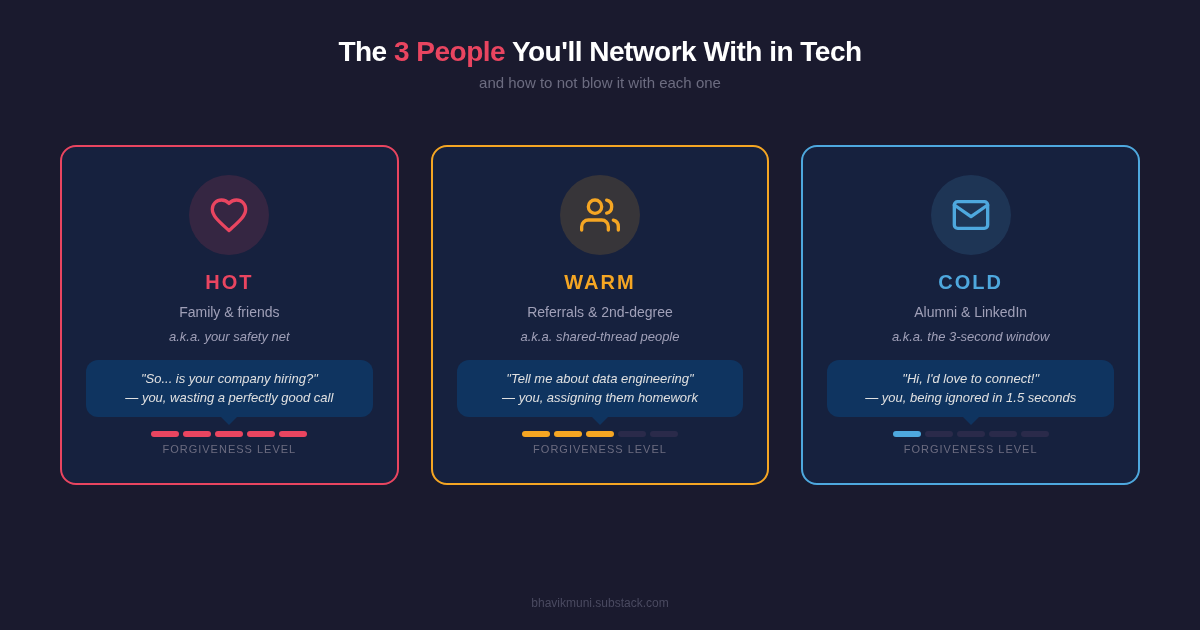
I asked Claude to come up with an appropriate banner :P
Category 1:
Hot contacts, your safety net
These are your people. Family, close friends, your mom’s friend’s kid who works in tech. The reason they’re helping could be anything — your moms went to school together, he’s your best friend’s younger brother, or you’re just a good person and they want to help. These people don’t judge you. Even if you’re underresearched, even if you’re wrong about something, it’s pardonable.
And that’s exactly why most people waste these calls.
Let’s say you’re a final-year grad looking for a role in tech. You reach out to someone in this category with one mindset: I need a job, let me ask if their company is hiring. If you lead with that, you miss out on so much, how they paid off tuition loans, what managing family expectations looks like as an international student, or what a data engineering role actually involves day-to-day versus what you think it involves from reading job descriptions at 2 AM. Basically your potential emotional shoulder to cry on.
The line of questioning here should be broad. Very broad. You’re casting a wide net because you don’t know what might end up being useful.
-
Lead with How are you? it communicates you’re a human, not a heat-seeking missile locked onto a job requisition.
-
Then try What do you do? open-ended, lets them hand you keywords you can remember or double-click on.
-
Follow with What got you interested in what you do right now? this lets them share their passions, be vulnerable, and tell you what their myths were versus what turned out to be true.
Before asking “what would you advise me to do,” fill them in with keywords about yourself first. Here’s why
Psychologist Ellen Langer ran a study
(referenced in Cialdini’s Influence: Science and Practice
Where researchers tried cutting in line at a copy machine. When they said “Can I use the machine because I need to make copies” a reason that explains literally nothing, 93% of people let them cut. Nearly the same as giving a real reason.
People stop processing after a keyword-trigger.
We do the same in conversations, people build entire theories about us based on the keywords we hand them. Be thoughtful about your framing. And always respect time. Just because the call stretches past 30 minutes doesn’t mean you cash in. Check in: “Hey, it’s been about 45 minutes - are you okay to keep going?”
Category 2:
Warm contacts — the shared-thread people
Referrals, second-level connections. Your brother’s best friend’s colleague, or an alum with a soft spot for fellow alums. There’s a shared experience — time with your brother, or time at the same college, and that’s your entry ticket. But beyond that, how useful the conversation is depends entirely on you.
These people will be amenable to some gaps, say, not knowing the precise difference between data engineering and data science. But not knowing the difference between a software engineering role and a data engineering role? That’s a different level. You can be somewhat vague, but you need to be thematically specific.
Here’s the difference: “I’m looking for data engineering roles, can you share more about it?” does NOT go as far as “I’ve always been interested in data, I think I’m decent at pandas, and I’m exploring which specific data role fits me.” The first assigns a task. The second invites a conversation.
Their memory of why they’re talking to you won’t last forever. Keep the shared thread warm, a brief mention of the brother you both respect, or the university you both went to, reminds them why they said yes. And do your research. If someone works in data analytics after shutting down their startup two years ago, asking “Can I join your startup?” infuses needless melancholy. Lead with: “I’ve always wondered what actually happens in the role you’re currently in.”
Show humility and curiosity.
If mentorship is a function, the input is curiosity and the output is wisdom:
f(curiosity) = wisdom.
End the call with a potential output from them, not you. Ask for resume feedback, or: “Is there anyone in your circle you think I’d benefit from talking to?” Let them suggest names, picking four people off their LinkedIn limits who they could’ve thought of on their own.
**Category 3: ** Cold contacts, the three-second window
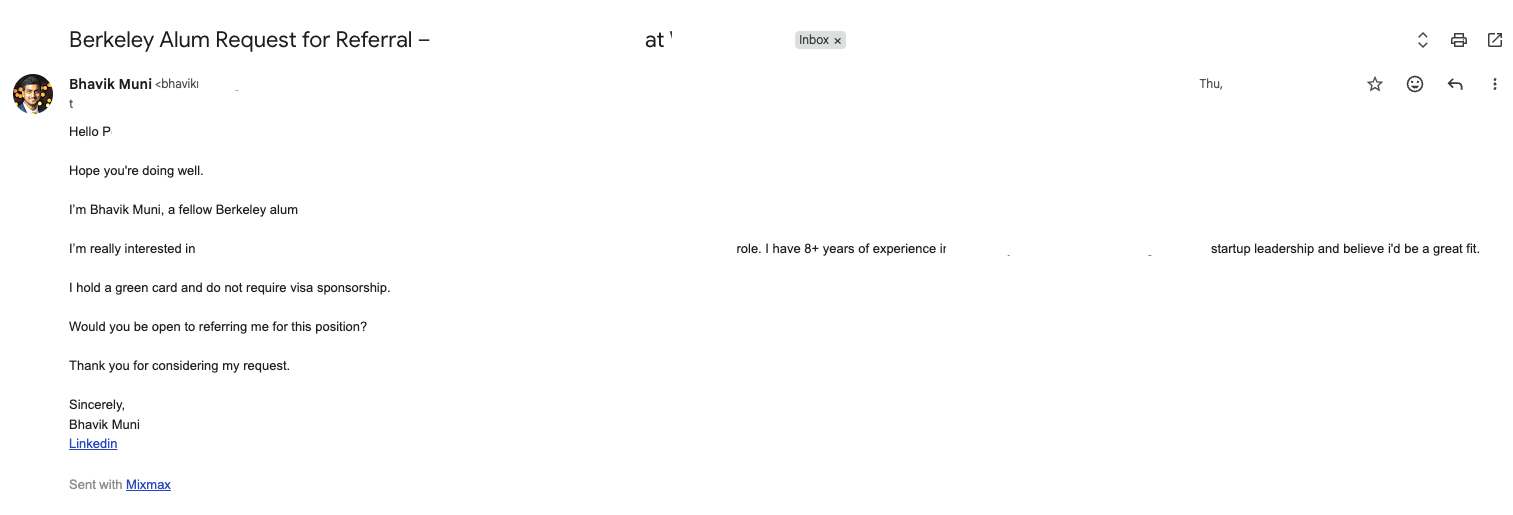
My cold-email template to fellow alums - received over 40% response rate.
Conference run-ins, cold emails to alumni networks, LinkedIn outreach. While alumni could potentially fall into Category 2, it depends, you have to gauge their vibe and initial response. It’s not complicated if you put yourself in their shoes.
This category gives you three seconds. Sometimes less. Make it amply clear what you want and why they should care. When I was job searching, I sent cold emails to about 100 alumni in specific roles, my experience, why I was reaching out to them, and a clear call to action. I got a ton of responses from that template.
If you’re good at reading people, you can sometimes push a Category 3 into 2. But this seldom happens, cold outreach is output-focused by nature.
Three Takeaways
1. Leave silent gaps. In The McKinsey Way, Ethan Rasiel describes how consultants extract the most valuable information by letting silence hang after someone answers. Most people can’t handle dead air, they’ll fill it with the most unscripted thing they’ve said all conversation. Data from you is useless to you. Data from them is gold.
2. Be overtly humble. “This is my understanding of the difference between data engineering and data science, but I’d love to hear your take” is far more effective than “Data engineering involves managing pipelines and ensuring data availability — but what about data science?” In the second version, you lost the chance to learn whether your understanding of data engineering was even right.
3. Thank them. You can never thank anybody enough, as long as you’re genuine. Not their time, not the connection, and certainly not the opportunity to be referred or hired.
The long game
By the law of large numbers, you’ll get the fewest responses from Category 3, more from Category 2, and the most from Category 1. But most people are good and reasonable. You may come across someone where none of this works — not because something’s wrong with them or these principles. It’s just not the right timing. Move on.
I wish you all the success in your pursuit.
Bhavik Muni is a product analytics professional, recovering startup founder, and apparently now a networking advice columnist. He lives in Utah and is available to talk about any of this over chai. Find him on Twitter/X.
If you know someone in tech who treats every networking call like a job interview, send them this.